.svg)


Václav Kazda: Book publishing is both an adventure and a constant investment in uncertainty

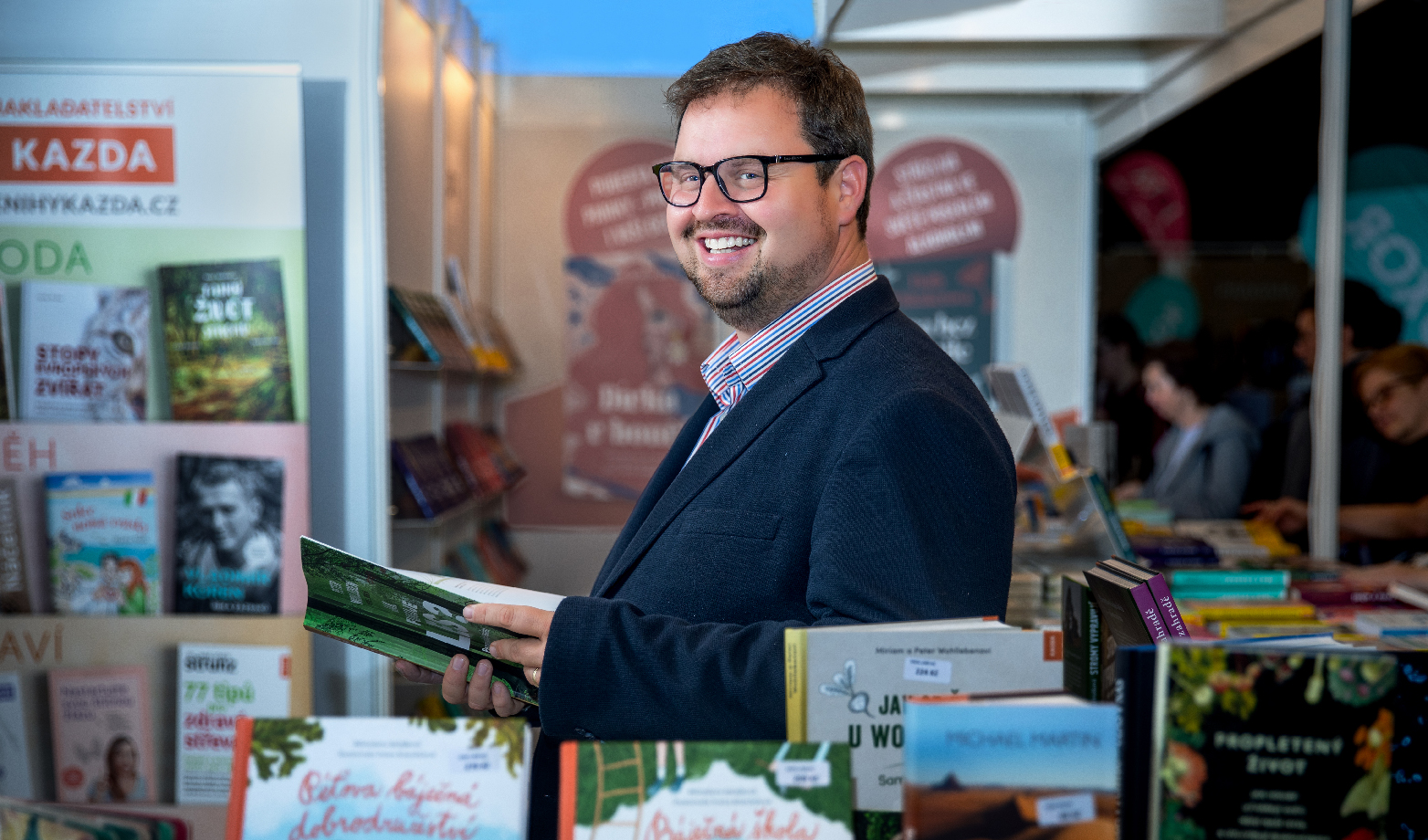
Kazda Publishing is one of the notable Czech publishing houses focused on books about nature, healthy living and personal development. The idea of starting their own publishing house came to the Kazdas through a book they read more than twenty years ago.
In this interview, co-owner Václav Kazda openly describes how their entrepreneurial journey developed, why the book business is so capital-intensive, how to manage a remote team and why, for the Kazdas, the meaning behind the books they publish remains more important than quick commercial success.






How does it work?
- Just fill in a quick form on our website.
- Simply connect data from your POS system, e-shop, accounting, and bank.
- Flowpay evaluates your ability to repay based on real data from your business.
- You’ll immediately receive a loan offer tailored to your business.

What led you to start a publishing business?
I studied cultural management and come from an artistic family, so it felt natural to consider moving in this direction. While I was still at university, I also gained experience at a small publishing house in Brno. Around 2014, shortly after getting married, my wife and I began thinking about starting a project together. At the time, we were greatly inspired by Miloš Kočka’s book Prameny živé vody, which tells the story of Vincenz Priessnitz. It brought together themes of nature, hydrotherapy and the Jeseníky region. We thought we could publish books about nature and try focusing on titles in this area. We started slowly, then began attending book fairs in London and Frankfurt, and things gradually took off.
So would it be fair to say that the initial impulse came from both a particular book and the stage of life you were in at the time?
Yes. It was a combination of both. We had just got married and were thinking about what we wanted to do and where we wanted to live. At the same time, I already knew something about books. Even though it has not been easy, looking back I have to say it was the right decision for me. It is a wonderful job, although in some ways it can also be daunting.
What were the early days like?
We started very slowly. We published one book a year and never imagined that it would grow into a publishing house that now releases around 40 to 45 titles annually. The beginning was full of excitement. I remember sitting over an aperitif in Italy while handling our first orders remotely. We were happy. It felt like the beginning of a new life with new possibilities. Suddenly, we did not have a boss.
At the same time, difficulties appeared right from the start. To publish books and gradually increase the number of titles, you need a great deal of cash. In my view, that is one of the hardest things about running a publishing house. With every book, you have to invest hundreds of thousands of Czech crowns upfront. As young people fresh out of university, we simply did not have that kind of money. We tried to finance our first books from our salaries and quickly realised that this was not sustainable. It was nerve-racking, but in the end, the excitement won out.
How does it work?
- Just fill in a quick form on our website.
- Simply connect data from your POS system, e-shop, accounting, and bank.
- Flowpay evaluates your ability to repay based on real data from your business.
- You’ll immediately receive a loan offer tailored to your business.
What makes publishing different from other types of business in your view?
Unlike in some other industries, there is not the same level of natural demand. It is a risky business because you invest in a product on the assumption that people will want it. You have to produce it in advance, often in fairly large print runs, then promote it and only afterwards can you sell it. You never know in advance whether it will work. It is a constant search. Over time, you gain experience, but the market changes very quickly, and so do readers and their tastes.
From an investment perspective, it is very demanding. Every year, you have to publish new titles and invest significant sums again, say CZK 10 million a year. You never stop investing. To me, that is one of the defining features of publishing: the constant need for fresh investment combined with a high degree of uncertainty.
At the same time, I feel there is a certain sense of community within the book industry. There is no enormous amount of money involved, and people generally treat one another fairly. You are sometimes in contact even with your competitors, you share certain information and, to some extent, stick together, despite still competing with one another.
What makes this kind of business particularly challenging?
Above all, it is psychologically demanding. The work itself is not necessarily the hardest part. It is the movement of money that creates the pressure. For most publishers, it is an adventure. We have also chosen a more idealistic path. We are not driven purely by commercial considerations. We do not try to publish only titles that are easy to sell. We focus on personal development, nature and health. That makes it a more difficult route. It is certainly not an easy ride. But in the end, it is worth it.
You publish many books on personal development, nature and health. Does your own outlook on life influence the way you run the business?
I think it does. Perhaps more than is healthy. Looking back, the primary purpose of our publishing house has never been to generate a large profit at any cost. If making as much money as possible were my main goal, I would publish completely different books. We try to take an idealistic approach. We publish books that we believe readers want, but also books that we feel are needed. We are not focused purely on entertainment, although I have nothing against entertainment. We want to take things a little more seriously, and we feel a certain responsibility for the development of the book market.
It is not a purely calculated approach where we see that a particular genre is popular and build the company around it. That is a perfectly legitimate strategy, but it is not ours. We do not want to opportunistically chase whatever happens to be working at the moment. We try, in our own small way, to contribute to society and bring readers genres that may not currently be fashionable but that we believe have value.
How does it work?
- Just fill in a quick form on our website.
- Simply connect data from your POS system, e-shop, accounting, and bank.
- Flowpay evaluates your ability to repay based on real data from your business.
- You’ll immediately receive a loan offer tailored to your business.
Your publishing house does not operate like a traditional centralised editorial office. How do you manage a remote team?
You are constantly learning as you go. I manage the team in much the same way as anyone else, through phone calls, emails and regular meetings at different events. I try to keep the structure as simple as possible. Once a company reaches a certain size, managing remotely becomes difficult. The key is having people on the team whom you can rely on, whom you can trust and who trust you in return. Remote work is not for everyone, particularly when it is a long-term arrangement. I have been working this way for 15 years. But you have to develop certain psychological mechanisms to make it work.
What is the most important thing when managing a remote team?
Trust. That is what I would emphasise above everything else. You have to trust one another. If there are problems, you need to communicate them. People have to take responsibility and care about getting things done when they need to be done. After 12 years of running the company, I can see that the relationship ultimately stands or falls on trust. Without it, things simply cannot work in the long term. Of course, you can discuss how to track work more effectively, how to share data or how to set up processes. All of that is useful. But none of it is enough on its own if you cannot rely on one another.
How do you choose people you feel you can trust?
I rely heavily on intuition. You look at people’s CVs and sometimes a candidate may not have the ideal profile in terms of experience, but you sense that the relationship could work on a personal level. You feel that you will understand one another and be able to trust each other. That may come from a similar educational background, similar life experiences or shared values. In my case, that approach has proved to work. Sometimes you can have highly capable people, but if your values are different, the relationship will ultimately fail. From my perspective, it is better to hire someone who can grow into the role over time but respects the company culture and genuinely fits within it.
What do you enjoy most about being a publisher?
There is no single thing. I enjoy being in contact with authors, travelling to European book fairs and acquiring rights. Those events lead to friendships and personal connections that are very valuable to me. I also value the freedom. I can choose a title I believe in and introduce it to Czech readers. I appreciate having the opportunity to play a part in shaping the Czech cultural landscape. I enjoy events such as Svět knihy (Prague Book Fair). Most of the time, you are working at a computer, but then suddenly you see all the books together in one place and realise how much work you have actually accomplished.
I enjoy working with my team. I can rely on them and I know they take what they do seriously. Overall, what I enjoy most is the international collaboration, the books themselves, the freedom and the opportunity to create something that has value for other people.
How does it work?
- Just fill in a quick form on our website.
- Simply connect data from your POS system, e-shop, accounting, and bank.
- Flowpay evaluates your ability to repay based on real data from your business.
- You’ll immediately receive a loan offer tailored to your business.
How does it work?
- Just fill in a quick form on our website.
- Simply connect data from your POS system, e-shop, accounting, and bank.
- Flowpay evaluates your ability to repay based on real data from your business.
- You’ll immediately receive a loan offer tailored to your business.
How does it work?
- Just fill in a quick form on our website.
- Simply connect data from your POS system, e-shop, accounting, and bank.
- Flowpay evaluates your ability to repay based on real data from your business.
- You’ll immediately receive a loan offer tailored to your business.
How does it work?
- Just fill in a quick form on our website.
- Simply connect data from your POS system, e-shop, accounting, and bank.
- Flowpay evaluates your ability to repay based on real data from your business.
- You’ll immediately receive a loan offer tailored to your business.



%20kopie.jpg)